

A major scientific milestone for Salzburg University of Applied Sciences: the Department of Information Technologies was represented at the International Conference on Machine Learning (ICML) 2026 with an outstanding research contribution. ICML is widely recognised as one of the world’s most prestigious conferences in the fields of Artificial Intelligence (AI) and Machine Learning.
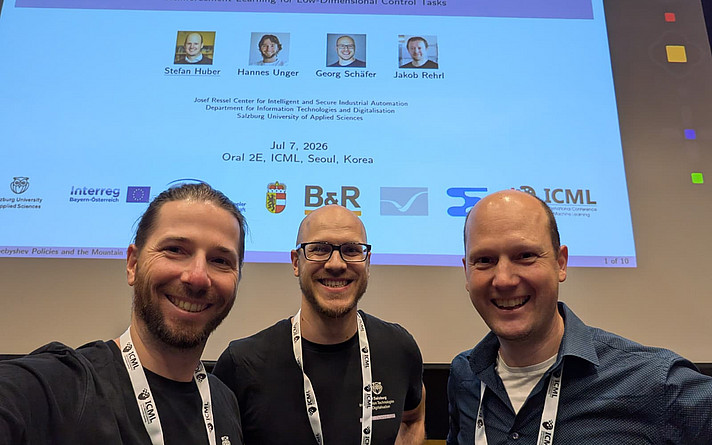
With more than 24,000 submitted research papers and over 20,000 participants, ICML ranks among the world’s most important forums for artificial intelligence research. Only around a quarter of all submissions were accepted for presentation. The fact that the research group from the Josef Ressel Centre for Intelligent and Secure Industrial Automation (JRZ ISIA) was additionally selected for a Spotlight Presentation, placing it among the top 2.2% of all submissions, highlights the exceptional scientific quality of the work.
For Salzburg University of Applied Sciences, and particularly for the Department of Information Technologies, this achievement marks a significant milestone. It demonstrates that excellent fundamental research conducted by a comparatively small research group can achieve international visibility and the highest levels of scientific recognition.
Four Years of Development, Eighteen Months of Research on a Single Paper
This success is the result of long-term scientific commitment. The award-winning paper builds on four years of dedicated development of the JRZ ISIA and eighteen months of intensive research focused on this specific challenge.
At the heart of the work lies a problem in Reinforcement Learning (RL), a branch of artificial intelligence in which learning systems independently develop strategies by learning from success and failure. Reinforcement Learning underpins many modern applications, including autonomous vehicles, robotics, energy optimisation and intelligent assistance systems.
The research team succeeded in solving a 36-year-old mathematical problem related to the well-known RL benchmark “Mountain Car.” Based on this breakthrough, the team developed a new class of reinforcement learning policies using multidimensional Chebyshev polynomials, significantly outperforming the current state of the art.
Another major contribution of the research is that, for the first time, the optimal solution to this benchmark problem could be determined exactly. This makes it possible to objectively evaluate existing RL methods by measuring their actual distance from the optimum, representing an important step forward for the entire research field.
From Fundamental Research to Industrial Innovation
The scientific findings extend far beyond theory.
They have also formed the basis of a joint patent application with B&R/ABB for the energy-optimal control of electric motors. This demonstrates how fundamental research can directly lead to industrial innovation and practical applications.
FH Salzburg Rector Dominik Engel: “Solving a problem that has remained open for 36 years, deriving a new class of reinforcement-learning policies from it, and surpassing the current state of the art in the process is a genuine breakthrough. The fact that this breakthrough also forms the foundation of the joint patent application with B&R/ABB demonstrates the remarkable potential of the Josef Ressel Centre model when fundamental research and industrial application are truly integrated.”

Strong Response to FH Salzburg Research at ICML
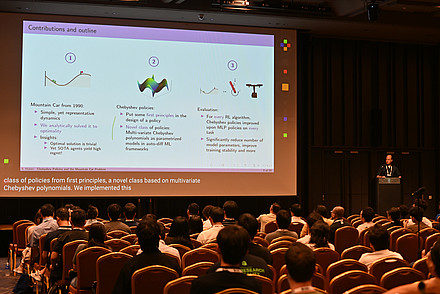
The research also attracted considerable attention during the conference. The team first presented its findings in a Spotlight Presentation and then discussed the results further during a poster session.
The theoretical foundations of the new method, in particular, sparked lively discussions. Many researchers were surprised that the solution had not been achieved through traditional optimal control techniques, but rather through an entirely new mathematical approach.
One conference participant told the research team that his doctoral research, around ten years ago, had focused on the very same Mountain Car problem. He recalled often wondering what the true optimal solution would look like. Learning that this question has now been answered for the first time was, he said, a particularly meaningful moment.
Setting New Benchmarks in AI Research
Reinforcement Learning enables intelligent systems to learn complex decision-making processes autonomously, with applications ranging from autonomous vehicles and robotics to energy systems and modern AI assistants. Until now, however, it has often been unclear how far existing methods for many standard benchmark problems were from the actual optimum. Thanks to the newly discovered exact solution, this question can now be answered scientifically and objectively.
The research also demonstrates that suitable mathematical models, in this case Chebyshev polynomials, can significantly outperform neural networks in certain applications. The newly developed approach reduces the gap to the optimal solution by a factor of six, opening up new possibilities for future Reinforcement Learning methods.
The research team led by Stefan Huber is already working on the next generation of these methods. Their goal is to combine the advantages of the new mathematical approaches with the strengths of neural networks, creating hybrid techniques capable of efficiently solving highly complex, high-dimensional applications such as humanoid robotics.
With its presentation at ICML 2026, the Department of Information Technologies has demonstrated impressively that research at Salzburg University of Applied Sciences is internationally visible and capable of making scientific contributions with an impact far beyond the university itself.

Stefan Huber
Head of Josef Ressel Centre ISIA
Our goal was never simply to make an existing algorithm slightly better. We wanted to understand how far today’s reinforcement learning methods actually are from the optimal solution. The fact that this led to the solution of a problem that had remained unsolved for 36 years, while also producing results that can be transferred to industrial applications, demonstrates the tremendous potential of long-term fundamental research.