

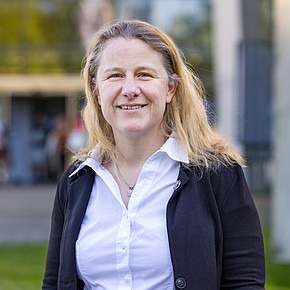
As of May, Cornelia Schneider has assumed the role of Head of the Department of Information Technologies and Digitalisation at Salzburg University of Applied Sciences. She succeeds Gerhard Jöchtl, who shaped and led the department for more than 30 years. Cornelia Schneider brings extensive experience from research, teaching and industry and has defined clear priorities for the future development of the department.
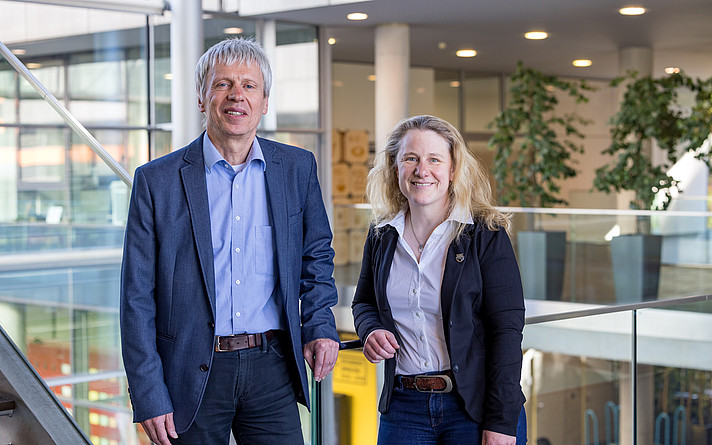
With the retirement of Gerhard Jöchtl, Salzburg University of Applied Sciences bids farewell to a defining figure in its history. Over more than three decades, he built and continuously developed the IT Department. His strong commitment to practice‑oriented teaching, close cooperation with industry, and the consistent expansion of research activities and degree programmes in the field of information technology deserve particular recognition.
Today, the department is one of the university’s central education hubs for information technology and a key research partner in the region – a development that is largely attributable to Gerhard Jöchtl’s long‑standing dedication and leadership.
A Clear Vision for Salzburg as a Digital Hub
One of the key objectives of the new Head of Department is to further strengthen Salzburg as a location for digitalisation and applied computer science. The focus will be on forward‑looking fields such as Industrial Informatics, which connects IT with industrial applications, as well as Cyber Security, Artificial Intelligence, Systems Engineering and Robotics. The department aims to serve as a central point of contact for both students and companies, actively shaping technological developments.
FH Rector Dominik Engel emphasises: “We are delighted to welcome Cornelia Schneider as the new Head of Department. She brings not only outstanding professional expertise, but also fresh momentum for the continued development of our institution. I am confident that, together with her team, she will set important impulses and successfully advance the department’s work. At the same time, I would like to express my sincere thanks to Gerhard Jöchtl, who shaped the department for more than 30 years with great dedication, foresight and a strong sense of responsibility.”
Practice‑Oriented Education and Strong Research
Cornelia Schneider emphasises: “One of our key priorities is to continuously adapt the range of degree programmes to current requirements and keep them aligned with developments in the field, in order to provide our students with a solid and future‑oriented education. Existing strengths in research at the IT Department should be reflected even more strongly in our degree programmes going forward.”
At the same time, cooperation with regional industry partners will be further expanded to bring research and teaching closer to practical application and to sustainably establish the department as a central innovation and knowledge transfer hub in the region.
Focus on the Future and a Clear Profile
The department places a strong focus on key technological developments and their application in complex industrial systems; emerging trends such as quantum computing are also being closely monitored. “Our ambition is not only to keep pace with technological developments, but to actively contribute to their advancement,” Schneider adds.
In addition, these developments are expected to be increasingly transferred to new application areas such as life sciences and healthcare. Alongside technical expertise, systems thinking, interface competence and the ability to design and manage complex systems are becoming ever more important. Lifelong learning will therefore be an integral part of future education and professional development.
The IT Department of Salzburg University of Applied Sciences serves as a central point of contact for IT and digitalisation in the region. This role is to be further strengthened through close collaboration with industry, academia and research. The aim is to consolidate this position in the long term and to reinforce Salzburg as an innovative hub for IT and digitalisation, Schneider concludes.