Shaping the future together: The Bachelor's degree programme "Architecture – Green Building & Adaptive Reuse" lets you study architecture with a focus on sustainable buildings that have a positive impact on our climate and living environment. You will learn to look at buildings holistically and to design them to be more resilient, more sustainable and more socially responsible. Planning with renewable materials plays a key role in this. Alongside new construction, working with existing building stock is one of our central themes, covering both refurbishment and extensions. With this degree, you will become part of a new generation of architects who can bring about lasting change in the world we live in.
| Type of study: | Full-time (compatible with employment) |
|---|---|
| Degree: | Bachelor of Science in Engineering (BSc) |
| Duration: | 6 semesters (180 ECTS) |
| Study places per year: | 35 |
| Location: | Campus Kuchl |
| Language of instruction: | German |
| Tuition fee: | €363 per semester + ÖH membership fee (€26.20 per semester) |
| Teaching times: | Lectures and seminars on Thursdays and Fridays from 08:15, studio work and tutorials in the workspace from Monday to Friday + elective subjects, excursions, Open Talks, guest lectures |
| Prior knowledge: | No subject-specific prior knowledge required |
| * | Subject to approval by the relevant committees Formerly "Green Building – Design & Engineering" |
Why Study Architecture at FH Salzburg?
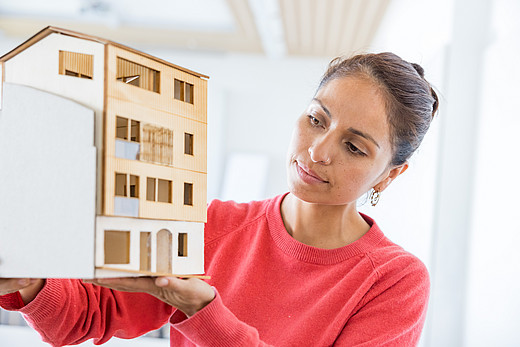
The Bachelor's programme "Architecture – Green Building & Adaptive Reuse" combines the fundamentals of classical architectural education with innovative approaches to sustainable construction and energy efficiency. A further focus is on a responsible approach to the existing building stock, particularly that of the Kulturraum Salzburg (Salzburg cultural region). In addition to design and technical competence, this requires a scientifically grounded engagement with historic structures, building culture, typologies and processes of social change.
In our courses, we teach you the skills to integrate the principles of the circular economy and low-carbon design into your future practice. This is supported by theoretical and practical knowledge in structural design, building physics, and energy and building services engineering. The programme sharpens your awareness of placing people and the environment at the centre. It also raises awareness of the responsible use of natural resources, without losing sight of economic aspects. Project work in every semester allows you to apply and deepen the knowledge you have acquired.
The Bachelor's programme "Architecture – Green Building & Adaptive Reuse" trains architects who, building on the integrative approach of academic teaching, think holistically, sustainably and interdisciplinarily, and who also:
- plan adaptively within existing buildings and take regional aspects into account
- plan based on life cycle assessment, with a material-conscious and circular approach
- consider climate-adapted building systems and work with renewable energy technologies
- plan and redesign buildings and neighbourhoods to be climate-resilient and robust
- experiment with timber and regional resources
- learn to take on key coordinating competencies
Teaching format: Courses are held full-time, essentially on site at Campus Kuchl, with in-person sessions combined with online teaching. These are complemented by excursions, tutorials, project weeks, symposia and guest lectures. Workspaces allow students to work continuously on their design projects, on drawings and models, and to engage in professional and informal exchange within their study group.
Theory meets practice: Thanks to the programme's structure, which is compatible with employment, with compact lectures on two days and studio work throughout the week, the knowledge you gain can be applied directly in practice.
Course content and areas of focus
The first stage of the programme provides a broad foundation of knowledge across all relevant fields of study. The focus is on designing and constructing a building yourself, supported by courses such as representation and architectural theory, as well as structural design and building physics. This methodological expertise is complemented by aspects of sustainability, resource efficiency and circular construction, which are applied in project work and tutorials.
In the second stage, the range of course content is expanded to include construction economics and building law, urban and open space planning, various simulation methods and working with existing buildings, as well as opportunities to deepen individual areas of specialisation within the elective fields. At the end of the final year of study, students reflect on what they have learned through the analysis of exemplary building projects and a second subject-specific design project, as well as the Bachelor's thesis.