

The Radiological Technology degree programme prepares students to become specialists in the application of diagnostic imaging and therapeutic procedures under their own professional responsibility. These procedures are used in the fields of radiological diagnostics, nuclear medicine and radiotherapy.
Degree Programme Radiation Technology
Studying Radiological Technology in Salzburg
Radiological technologists combine medical knowledge with specialist expertise in Radiological Technology. Acting on a physician’s instructions, they carry out diagnostic examinations as well as nuclear medicine and radiotherapy treatments under their own professional responsibility. In doing so, they make well-founded professional decisions, operate modern medical technology systems and ensure safe, high-quality patient care.2
Throughout the entire process, they support patients and serve as competent points of contact. In addition to professional precision, empathy, communication skills and a strong sense of responsibility are therefore essential. The Bachelor’s degree programme has a strong practical focus and combines subject-specific and methodological content with scientific, interpersonal and communication skills. Upon successful completion, you obtain not only an academic degree but also full professional authorisation to practise in a regulated healthcare profession.
Requirements for Students
- empathy in interactions with patients
- an interest in medicine, the natural sciences and technology
- spatial awareness
Curriculum Structure Radiation Technology
In the first year of study, you acquire fundamental knowledge in medicine, the natural sciences and technology. This includes anatomy, physiology, pathology, radiation physics and radiation protection. Building on this foundation, you further develop your expertise in radiological diagnostics and interventional radiology, nuclear medicine diagnostics and therapy, and the planning and delivery of radiotherapy treatments.
From the second semester onwards, the theoretical curriculum is complemented by clinical placements. These continue throughout the programme and enable you to apply your knowledge progressively in clinical practice while developing professional decision-making and practical skills. During the placement semester in the final year, you can choose an individual area of specialisation according to your professional interests. The extended placement in the fifth semester may also be completed abroad.
In addition to the Bachelor’s thesis, the final year includes interdisciplinary, scientific and research-oriented content. Courses in law and economics, communication, statistics and other relevant subjects broaden your professional competence and prepare you to practise under your own professional responsibility.
Areas of Specialisation
Radiological Diagnostics and Interventional Radiology
- X-ray imaging, fluoroscopy and mammography
- Computed tomography and magnetic resonance imaging, including the use of contrast media
- Ultrasound examinations
- Angiography and cardiac angiography
- Assistance with interventional radiology procedures
- Radiological diagnostics is an interdisciplinary field that supports almost all medical specialties in diagnosis, treatment planning and follow-up assessment.
Nuclear Medicine
This field encompasses the diagnostic and therapeutic use of unsealed radioactive substances:
- preparation and administration of radiopharmaceuticals
- examinations using gamma cameras
- single-photon emission computed tomography (SPECT)
- positron emission tomography (PET)
- nuclear medicine therapies
- dosimetry and radiation protection
In the nuclear medicine specialisation, you learn to prepare and administer radiopharmaceuticals appro-priately for diagnostic examinations and therapeutic treatments. While other imaging procedures primarily depict anatomical structures, nuclear medicine enables the assessment of functional and molecular processes. These include metabolic, transport and excretory processes.
Radiotherapy
This field encompasses the planning and delivery of radiotherapy treatments:
- radiotherapy treatment planning
- image-guided preparation and simulation of treatment
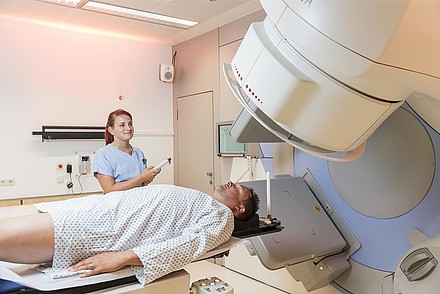
- operation of linear accelerators
- use of applicators and treatment equipment in brachytherapy
- dosimetry
- quality assurance and radiation protection
In radiotherapy, ionising radiation is used specifically to treat diseases, particularly cancer. You learn to contribute to treatment planning, position patients precisely and carry out radiotherapy treatments prescribed by a physician under your own professional responsibility. Patient care is delivered in close collaboration with physicians, medical physicists, nursing professionals and other healthcare professionals.